
Interview with NARO Researcher Ramathani Idd — Part One

How Skeepon Is Changing Dry-Season Farming in Uganda
For the past three years, AC-Planta has been conducting joint field trials of Skeepon with Uganda’s National Agricultural Research Organisation (NARO). Product registration in Uganda was approved last year.
Ugandan agriculture is facing increasingly serious drought, extreme heat, and water shortages as a result of climate change.
We spoke with Ramathani Idd, a NARO researcher and one of the core members of the joint Skeepon trials, about the challenges facing Ugandan farmers, the effects observed in local field trials, and the future prospects for the technology.
This interview is presented in two parts.
What are the main challenges facing crop production in Uganda?
The greatest challenge has been water shortages and the droughts they cause.
Because of climate change, the heat during the dry season has become more severe each year. Shallow wells dry up very quickly, but introducing irrigation systems is expensive.
My area of research is vegetable growth. Under normal conditions, vegetables need to be watered twice a day—once in the morning and again in the evening. Securing the water itself is difficult, and the labor involved in irrigation is also a major burden.
How do Ugandan farmers obtain water for agriculture?
It varies from farmer to farmer.
Some collect rainwater in storage tanks. Others drill wells and use groundwater, while some connect their farms to the public water supply.
Drilling a well, however, requires a substantial initial investment. Farmers must pay for the drilling itself as well as a pump, a storage tank, and irrigation equipment.

What are Uganda’s principal crops?
The main crops differ from one region to another.
Coffee is Uganda’s most important export crop. Very little of it is consumed domestically, and coffee exports provide a major source of revenue for the country.
Major food crops include matoke, a variety of banana used for cooking, as well as maize, rice, cassava, sweet potatoes, sorghum, and millet. In some regions, oranges, mangoes, vegetables, and pasture crops for livestock are also important industries.
You first encountered Skeepon three years ago. What was your initial impression?
I first heard about Skeepon just as we were preparing to transplant some vegetable seedlings. To be honest, I did not simply accept the claims about its effects at first.
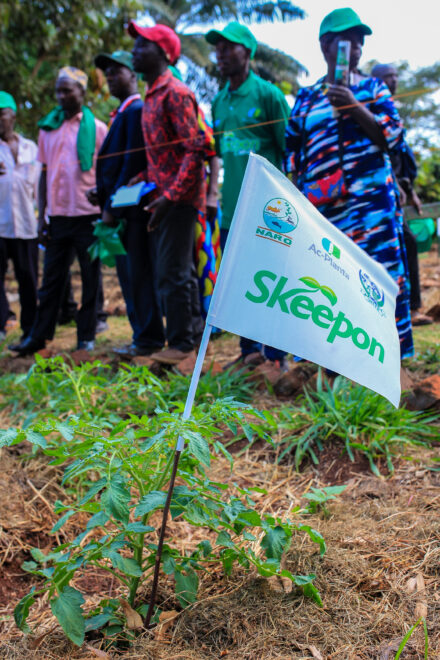
The first crop I tested was potted tomatoes. Normally, seedlings must be watered immediately after planting. The Skeepon-treated seedlings, however, remained upright and healthy even though they received no water for the entire day. By contrast, the untreated seedlings began to wilt after two or three days.
That was when I thought, “This is real.”
After two or three weeks, the difference became even clearer. Although it was the dry season, the Skeepon-treated tomato seedlings were growing rapidly.
What is the greatest benefit of using Skeepon?
The greatest benefit is that it has made it possible to grow crops during the dry season. We have been able to reduce both the amount of water used and the frequency of irrigation.
Farmers can sell vegetables at higher prices during the dry season than during the rainy season. A bucket of tomatoes, for example, may sell for around 5,000 Ugandan shillings—approximately 220 yen—during the rainy season. In the dry season, the price can rise to between 40,000 and 50,000 shillings, or approximately 1,800 to 2,200 yen.
Reducing the need for daily irrigation also allows farmers to use that time for other work, such as weeding.
During a normal dry season, crops must be watered twice a day, in the morning and evening. With Skeepon, the crops can remain healthy even when they are watered only once every two days. If a farmer irrigates today, they can spend tomorrow weeding instead.
This makes it possible for one person to handle several different tasks and helps reduce the impact of labor shortages and high labor costs.
For farmers who own wells or irrigation systems, the cost of electricity used to pump water and the cost of maintaining the equipment are also significant burdens. Reducing water use can therefore have a major economic benefit.
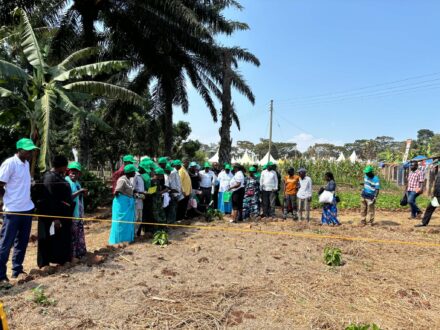
CAPTION: At an agricultural event in Uganda, Idd explains the condition of a Skeepon-treated coffee field to participants.
Which crops are currently included in NARO’s Skeepon trials?
We began with high-value horticultural crops such as tomatoes because they can generate good returns even when only a limited area of land is available.
We then expanded the trials to coffee as a cash crop and to maize and bananas because of their importance to food security. Skeepon is now also being used in the production of certified mango and orange seedlings to keep the young plants healthy and improve their survival rates.
NARO is currently focused on disseminating new technologies that can help agriculture adapt to climate change. We are examining how well crops can withstand drought, high temperatures, and salt stress. Skeepon is one of the technologies being tested on a wide range of crops.
I am also responsible for a pumpkin-breeding project. Skeepon-treated seedlings have maintained a high survival rate with watering only once or twice a week. I am seeing promising results from a plant-breeding perspective as well.
CAPTION: A Skeepon experimental field at NARO.
Skeepon has completed product registration in Uganda, and the focus has now shifted to adoption across the country. How have farmers responded?
There is a very high level of interest.
This year, we began visiting farming regions across Uganda to provide training for farmers. We begin with an explanation lasting approximately 30 minutes. We then move to a demonstration field, where we show the farmers how to dilute and apply the product.
We provide specific instructions for each crop so that farmers can begin using Skeepon themselves.
We have received requests from many different regions. Some areas have asked us to conduct training sessions for groups of 500 or even 1,000 farmers.
If you were to summarize the effects of Skeepon observed through your research in a few words, what would you say?
Skeepon is very easy to use. Farmers do not need special equipment such as protective clothing or masks.
It is environmentally friendly, and its effects can be seen within a relatively short period. Because it needs to be applied only once per growing season, it can also reduce costs over the long term.
These are the benefits I would like to communicate to farmers.
Continued in Part Two.